Macro placement decides where to place large components on a chip before its wires are routed. Each of these blocks, called a macro, is a pre-designed circuit. Macros that have wires connecting them should sit nearby so the wires stay short. However, macros that are too close leave no room to route those wires. Additionally, macros may not overlap.
Thinkorplace is the placer I designed and implemented for the Partcl/Hudson River Trading Macro Placement Challenge 2026. It finished ninth on the final leaderboard (of 132 verified eligible submissions) with a verified mean proxy of 0.9974. My score is a 31.6% improvement over the published RePlAce baseline. Runtime was 12 minutes per test case (max 60 minutes per test case).
Technical report (PDF) · Source code · Placement explorer
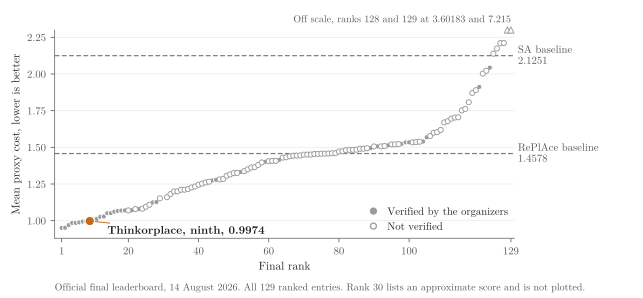
How entries were scored
Entries were ranked on 17 IBM benchmark designs using the proxy cost defined by Google’s Circuit Training combining wirelength, density, and congestion. Wirelength estimates how much wire is needed to connect each net. Density measures how crowded the layout is, averaging the most crowded 10% of grid cells. Congestion compares routing demand with the available routing tracks and averages the worst 5% of cells. Density and congestion each carry half the weight of wirelength. Lower scores are better.
The reference evaluator takes between 1.4 and 27 seconds to score a placement. That allows roughly 130 to 2,600 full evaluations per design in an hour, which makes it impractical to test individual moves this way.
How Thinkorplace works
Thinkorplace is a two stage process. First, it finds a quick approximation of a good overall layout. Then it refines that layout through small moves evaluated with the exact score.
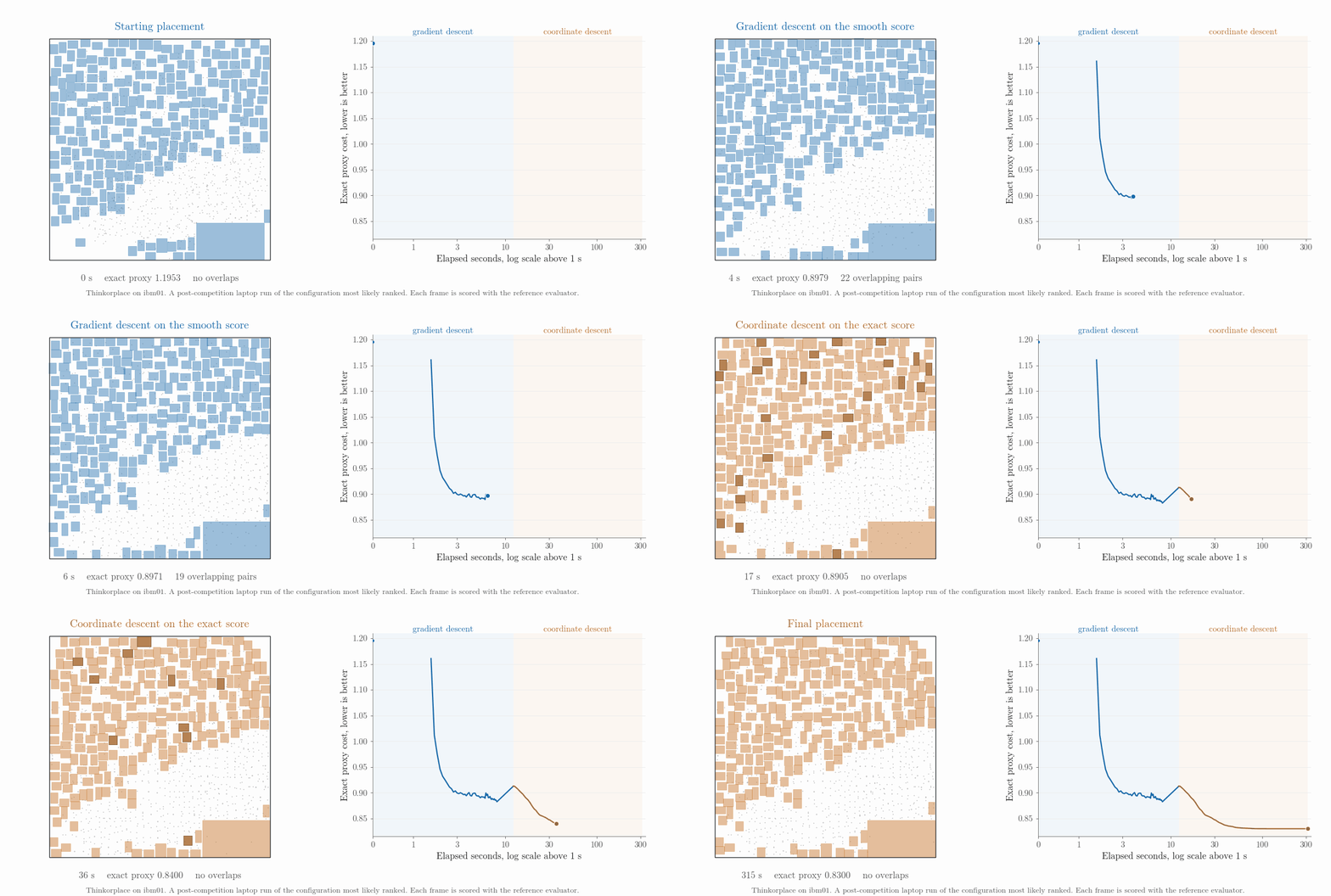
The first stage uses gradient descent on a smooth approximation of the score, allowing all the blocks to move together. A legalizer then resolves macro overlaps by moving overlapping macros into nearby free space, starting with the largest.
Because the approximation differs from the actual score, the second stage optimizes the actual score directly. It uses coordinate descent, moving one block along one axis at a time and accepting a move only if the exact score improves. Each block stays within the free gap around it, so accepted moves preserve a legal placement.
An incremental scorer makes this practical. Moving one block affects only a few nets and grid cells, so the scorer updates those instead of recalculating the entire placement. On sampled moves, this took 1.3 to 3.7 milliseconds, compared with 1.4 to 27 seconds for the reference evaluator. The scores agreed within floating-point rounding. That makes it possible to try about 100,000 moves in ten minutes instead of a few hundred.
What I learned
The simpler pipeline performed better in my May development runs. The earlier version combined two starting methods, three types of local search, and a curvature stage, taking 3,192 seconds per design. The two stage version took 524 seconds and scored 7.1% lower on average, improving 16 of the 17 designs. Lower congestion accounted for 84.5% of the gain. My best explanation is that exact local search tends to stay close to its starting layout, so a better starting point matters more than adding more search. Though, I haven’t tested that explanation by comparing the pipelines with the same compute budget.
Curvature kicks also helped, though I’m less sure what to make of that result. When local search stalled, I nudged the placement along a direction where the smooth model curved downward, then ran local search again. In research runs, this lowered the score in 190 of 204 attempts, but the directions and step sizes I tried worked about equally well. A random nudge followed by the same local search might therefore work just as well, though I haven’t run that control yet.
I also found that an optimal reassignment can make the placement worse. The Hungarian method finds the optimal assignment of blocks to slots for the costs it is given. Here, those costs treat each move as if every other block stays put. That assumption breaks when blocks sharing a net move together. In a constructed example with two blocks, the costs predict a wirelength decrease of 18, but making both moves increases wirelength by 14.
After the competition, I reran the configuration I believe was used for the ranked entry on my laptop’s CPU. It reached a mean proxy score of 0.98121, with valid placements for all 17 designs. The official run used different hardware, so this wasn’t a controlled comparison with the competition result.
All of these results are proxy scores, not measurements from a full place-and-route flow. I also developed the method on the same 17 public designs used for the ranking.
Thinkorplace is written in Python using PyTorch, NumPy, and SciPy, with support for CUDA and Apple GPUs.